Author: msanjay

  • interview with a butterfly

    [written in April 2004 but updated here to sync with the actual event]

    I = Interviewer
    B = butterfly

    I met some butterflies and asked each of them if they had some time to spare for a moment, none of them agreed. Finally I found one chap who said “yes while Im having a quick nectar-break – shoot!”

    (more…)

  • fruity punches

    An email exchange with friends… :mrgreen:

    (more…)

  • lessons from the Germans

    [date is only approximate. TODO: update date]

    Travelling is no doubt the greatest teacher, as long as one is willing to observe and learn. While travelling through Deutchland, I saw many characteristics about the Germans which I felt are worth emulating. My inferences may be based on limited experiences and may not be accurate. They are just some of my thoughts, and are in no way comprehensive. They focus mainly on the positive points, and are based on my visits to Dusseldorf, a city in the north-western part of Germany. Many of the points are applicable to many other countries too, including our own, and I don’t mean to compare too much.

    To start with, the sense of discipline of the Germans is their most prominent characteristic. This can be seen for example while driving on the roads. If you drive from a neighbouring country like Belgium and enter Germany, you can see a marked difference in the way the rules are followed. This discipline extends to various aspects of their life. Their sense of health-conciousness is very impressive. It is uncommon to see people overweight; people of all ages are generally in good shape. They are careful about their eating habits and watch what they eat. They generally eat a good breakfast and lunch, and have a very light dinner – sometimes just a little bread.

    Their respect for other people’s time is uncanny. I think the height of this was when one day, a friend was to pick me up along with some others from my room at 22:00 to go to some party, he called me at 21:45 to tell me he would be 10 minutes late.

    There are no set conventions, no matters of prestige and status to uphold. Even the richest people don’t hesitate to to take out their own trash, or ride a bicycle if they feel it more convinient than a car. Even when they visit someones home, they help the host clean up after dinner or take something like groceries for the host along with them. There are a lot of things I have learnt to appreciate about India which I just used to take for granted earlier, and our great sense of hospitability is one of them. But this duty of the guest to not impose on the host esp. for long two or three day visits was a real eye-opener. I have seen this being done here too but only limited to close family-friends.

    They have a great sense of pride and possessiveness for their own language, city, and country. An amazing incident was when I saw a lady who was sitting in a bus, got up and cleaned a dirty spot on the seat next to hers when she noticed it. On the other hand, there are always exceptions… for instance some unused bus or train terminals are dirty with broken bottles and at times, even the stench of urine. But the ratio of civic minded people far exceeds these ‘exceptional’ people – mostly drunkards since beer is available cheaper than water.

    They seem to be more or less self-content, not craving for more and more in life… happy with whatever they have. I wouldnt really go as far as to say they are all happy people, judging by the silent morose expressions I used to see on their faces in the trams, on the way back to my hotel room in the evenings.

    They have a lot of value for other people’s ‘personal space’. For example, while I was working there, anyone who came to talk to me usually conciously made sure they were facing away from my monitor when they approached me, so
    that it was made clear to me that it didnt matter to them if I had some mails open or the Developer studio at that point in time. And they would first ask me if they could interrupt, and then go on to start talking.

    They have a lot of respect for even total strangers; while commuting, they are very much aware of people around them. For example, even in places like shopping malls they usually hold on to the door for a second more after they
    entered so that it wouldnt close in the face of the person coming behind them.

    When a tram is about to leave from a station, and they see some person running to catch it from a distance, I have often observed someone press the button to open the door, even though they dont intend to board the tram… its just that
    they’re so observant and care about others.

    They are not workaholics and value their life too much to waste late evenings in the office. At the same time, their effectiveness at work during work hours is truly inspiring. The most ideal person I know came in the morning around 8:30 AM, and finished so many tasks by 6 PM that it would have taken any average person two days to finish the same number of tasks! They dont waste too much time for at coffeebreaks, etc. After work, their life begins, and different people have different hobbies which they do regularly more than just an occasional past time. One friend was a member of a rock band and composed and played music and had a well established garage studio! I had the priviledge of being invited to one of his rehearsals, and he gave me a CD that he had made of his bands latest album. People are not very addicted to television.

    Travelling is a popular hobby, and they love to see the world ‘as it is’. I judge this based on the observation that they travel with minimum baggage, sometimes just a rucksack, and are they are more likely to go around by walk or whatever local public transport available than in a rented car – this way they get a real ‘feel’ of the place than just see the place. They generally take atleast two really long vacations a year, to any of the neighbouring European countries, the more adventurous go further visiting Asia and America too.

    I think the aspect I liked the most about Germany was the greenery coexisting with the concrete jungle. They have a high regard for the environment and there are many parks where one can walk endlessly amidst nature, right in the middle of the city.

    I think a lot of civic amenties could easily be implemented here without much cost, the simplest one being maps of the city put up at various places. Or seperate bins for recycling and a good process in place.

    Last but not the least, when I visited a doctor there, I had an opportunity to witness a lot of beautiful ideas. While I was waiting at the opthamologist center, there was a section in the waiting room just for kids. There was a playpen with a lot of toys, paper and crayons, comic books, etc. There were a lot of posters on the wall having cartoons about eyes and the eye-doctor as seen from kids’ point of view. There was one interesting cartoon in which a kid’s vision has gotten a bit blurry, and his mom gets him to the eye-doctor, and the kid talks about how nervous he is. Then the process that the kid goes through at the hospital is clearly explained from a kid’s perspective, and at the end he is seen smiling happily having made a the eye-doctor as his new friend.

    Incidentally, as I was sitting in the waiting room, I heard the receptionist calling for a Harmuth again and again… was he deaf or what he didnt seem to hear though she called so many times. Names like Andreas, Harmuth, Stefan, etc are very common in Germany. If you were to go to a crowded market and make an announcement for a Harmuth, there would be a long queue at the announcement center. When my mind drifted back to the waiting room, this particular Harmuthad still not appeared. Maybe he had gone home tired of the indefinite waiting. Since I had nothing else to do I started thinking … Herr is ‘Mr.’ in German, and my last name was Mutt and then it flashed… they might be calling me Herr. Mutt (Mr. Mutt) since my full name is Sanjay Mysore Mutt (I had always called myself Sanjay M all my life till I went abroad and now I was usually confused about which to give for which part of the name) And it did turn out to be me she was looking for, and she asked me something in German which under the circumstances might have been something like where the %$%@# were you all this time? But luckily the doctor could speak English.

    One nice thing about the waiting room was that every time a new patient joined the waiting room, h
    e would greet everyone else as soon as he entered, and others would greet him back. Ocassionally this seemed to be just for formality’s sake, when the greeting would end up being just an incoherent grunt, but apart from that, it was cheerful most of the time.

    Germany is not just an ‘advanced’ country, it is continuosly advancing. On every visit to the city, one can see something new, some new models of trams, or some new touch-sensitive interactive train reservation terminal replacing the earlier mouse wheel and button based interactive train reservation terminal.

  • pushkar

    Took a bus from Ajmer to Pushkar This was supposed to be the holiest place
    in India. What I saw there was absolutely incredible contrary to all
    expectations. The place looked as cosmopoliton as Berlin or Paris, with
    internet surfing stations and banners of all kinds of international hotels
    (some with swimming pools) and camel rides and what not. The whole place was
    so unbelievably commericalied.

    a cut above the rest!

    Almost everybody was out
    to get some money, but as a lone guy with a backpack I managed to merge into
    the ambience without attracting too much of attention. Another thing was the
    way foreigners walk around dressed exactly like Indians, very much merged
    into the atmosphere and I felt that they had made it their home.

    [Actually I started this post with just one photo… but its started to
    become a narrative – and I just cant stop myself now! I wish I had
    maintained a diary then, now I can only vaguely recollect some things. ]

    During conversation with some pujaari there [Im not a hindi expert but
    manage to get my point across] he told me a story about the Pushkar lake –
    something to do with some lotus flower being dropped there from which the
    lake had sprung up. He said that was the only place in the world which had a
    temple for Brahma. I vaguely remembered some Amar Chitra Katha story about
    some competetion between Vishnu and Brahma on finding opposite ends of an
    infinite pillar of light. Both went in opposite directions, but Vishnu
    admitted he could not find the end, Brahma lied saying he did. Thats when
    another God came and declared that because of that nobody would ever worship
    Brahma.

    Anyway the pujaari told me to do some ritual in the name of my late father
    to give him salvation. Though I am not religious I just said ok fine. So he
    recited some mantras for a few minutes and broke a coconut etc, and at the
    end of it, he said “ab aap kisi brahman ko kuch dakshin dena hai”. Then I
    said “hmm… kis brahman ko? kaha se doondu mein us brahman ko”. And I’ll
    never forget his reply… he said wagging his hand pointing to himself “is
    brahman ko do! is brahman ko do!” and I paid him Rs 50 after some
    bargaining, hiding my laughter. But he had been a very nice person, it had
    been great talking to him.

    I walked around the perimeter of the huge Pushkar lake.

    At the other end in more secluded places… I
    saw some saadhus deep in a trance, and to my great surprise they seemed to
    be on smoking some drugs from a pot. Drugs were quite a common scene there…

    …but seeing all those sadhus like this was news to
    me. Walking around the perimeter I passed temples temples and more
    temples… around a 1000 temples somebody said.

    Here is the one and only temple for Brahma (the text in Hindi reads: Shri Jagath Pithaa Brahma Mandir Pushkar)

    Next day I also visited the Muslim dargah near Ajmer along with another
    friend – Rahul. Even this place was no exception wrt commericalization. Here people
    were more demanding… asking for money whether we wanted to or not. Upon
    entry of the dargah, a lot of people were squatting on the floor within the
    premises, and invited us to join them for some ritual or fortune telling or
    what I dont know. We were warned earlier itself that this would be the case,
    and if we were ever to conced and sit down, we would lose all money from our
    pockets, so we very diplomatically refused and walked on. We however had
    also been advised to buy flowers to place inside. Finally we reached the
    center of the dargah, where some great person was buried. [3 years later, I did a google search and found the name: Dargah of Khwaja Moinuddin Chishti] The visitors are to walk around the very beautifully decorated tomb (very similar to what is there
    inside the Taj Mahal). One person (priest?) had a bell shaped vessel, and
    every visitor would bow before him, and he would place it for a few moments
    on on top of the visitor’s head. It was quite crowded inside and everyone was pushing each other. Finally my turn came, and when he placed it on my head – I could feel some
    strange vibrations. He had not striked it or anything, he had simply placed it gently over my head. I had no explanation for it. Thoughts of all the commercialization and crowd etc faded away into a moment of silence which seemed to last forever – and I felt this was what it all came down to. I placed the flowers and joined my friend outside – who didnt have anything to say about his experience so I kept silent too.

    Ajmer was quite a crowded city. Long ago in Germany some Germans had asked,
    very earnestly… “do you have a lot of cows and elephants walking around in
    the middle of the streets in India?” and I had laughed at this typical
    attitude of foreigners. On the streets of Agra, Ajmer I laughed at myself
    for having laughed… for those words were turning out to be actually true!

    But this was a journey where for the first time I felt I had really experienced India in a deeper way.

    ———–
    Camera: Olympus D-460, autofocus
    Note: Some pictures might be edited for contrast.
    [Btw having been born and brought up in Bangalore and never travelled much except for family trips to places within 400 kms in the south, this was my first lone venture into the northern part of India]

  • visit to Ajmer

    In Ajmer I got dropped off on the outskirts of the city at 4 AM, the private overnight bus I had taken kindly informed many of its somewhat disgruntled passengers that it wasnt going to go all the way to the city center and pushed off, leaving the highway in darkness except for the dull light from the teashop. I took solace in the fact that there was this group of fellow passengers who were sharing my plight. I turned around and looked, what passengers? Most of them had disappeaered! I saw a large rickshaw with some arms and legs sticking out… and was angry with myself that I was distracted. After about half an hour, another one turned up. Competition for getting in was really fierce… with more people having emerged from the shadows. I was not used to this kind of thing – I had lost touch with footboarding BTS buses in my college days itself. As I tried to get a foot in, I was too late, the big auto was jam packed with some 10 people at the back, and two more in front. And when I thought no more can fit inside, he gave me 3 inches of space next to his seat! Luxury!

    I got on and hold on for dear life as it rocekted and bumped through what had been quiet sleepy neighbourhoods until its arrival, dropping off passengers one by one. I gave him the landmark and he dropped me somewhere and said this is what I know, you’ll have to go on from here, and he pushed off. I looked around, the street was completely empty, and I roamed around aimlessly, trying to get my bearings though I had no map, though even Im the kind of guy who, as my friends often remind me, would find it hard to find my way around Bangalore in broad daylight. Finally I came across a milkman cycling through a path, and he gave me directions following some circuitous route which I more or less forgot as soon as he disappeared around the corner.

    Either he had misdirected me, or I made enough number of mistakes in following the directions that corrected my route, but I ended up on one of the streets indicated by the address.
    Then I had to grope around in the darkness using some small device as torch (i didnt have a cell but cant remember what) to look at the house numbers… and I must say miraculously somehow ended up at Nirbhay’s house around 5:30 AM. I just couldnt believe I had made it, but anyway street number, house number, name everything matched according to my address.

    I found the gate locked, and nobody responded to the intermittent tapping I made with the bolt. Considering it was still the wee hours of the morning, I didnt feel like clanging and shouting loud enough to wake up the whole neighbourhood. Anyway one of the neighbours did venture outside, and I introduced myself to him. He warmly received me as if I was his own guest, woke up his wife inspite of my protests, who gave me some very welcome snacks and tea. We spoke for sometime and I even had a short nap, and finally met Nirbhay later.

  • the great journey within

    Mind and Matter

    One who has the aspiration to study, does maybe a masters degree, and then perhaps a post-graduate course in some further specialization. Mostly such courses have some highly competitive entrance exams. People finishing any course successfully may end up with the dream job of their choice. Or sometimes they may face disappointment in seeing that their peers in their earlier days, who had been working instead of studying, are much better off, and are actually in a relatively senior position. Or sometimes find out that by the time they’ve finished the course, their specialization is no longer in much demand… some may go on to do further research, make amazing discoveries and get awards, etc. …anything is possible depending on the interest and circumstances of the person. Whether to study further or not is a never-ending debate and everyone has his or her own opinions.

    But there is one course, for which the immensity of its value is indisputable. For this course, there is no entrance exam, and the only requirement is that one is a human being; whether one is a prodigal genius to intellectually challenged, multi-billionaire to desperately poor, sanyasi to terrorist… is completely immaterial. One might have read a plethora of books and articles and acquired a whole lot of theoretical knowledge already, or might be completely ignorant about the subject, all this doesn’t matter.

    I’ve been a computer programmer and, like most programmers, have always been fascinated with technology… a winding toy, electric trains, robotics, computer software … whatever I came across… I would try to find out how it worked, its underlying mechanism. Of course I’ve always wondered how the greatest technology imaginable, the human body, was ‘programmed’. Once I came to know about the Vipasana Meditation Research Center, I had no second thoughts on deciding to register as a student for the course. But 10 days is a long time for anyone’s schedule esp. a working individual, and it took considerable planning before I could finally arrange for the time off.

    What is below is a mix of my own thoughts along with what I learnt from the course The Art of Living – Vipasana Meditation. These are of course just my own personal perspectives, more authoritative information is found at the dhamma website, which contains comprehensive information about Vipassana… what it is all about, the schedules and venues (all around the world), contact information, etc.

    Clearing some misconceptions

    • Do not expect any dramatic changes instantly… (though there have been examples where some had dramatic results) The course is like a seed of a massive tree, the seed planted is very small to start with, and only if YOU (nobody else!) take care of it over time, it will become a massive tree.
    • After completion of the course, its not very likely that you will feel like renouncing the world and going to the forest, this message is proof that I haven’t done that (yet 😉 )
    • It is not just for old people who have retired and feel they have nothing else to do than sit and philosophize about life. A large percentage of the attendees were in their 20s, though up to 60 – 70 year olds were present too (so age no bar!) After all it’s about the Art of Living, and not the Art of How One Should Have Lived.
    • It’s not just for people who are stressed out or depressed, it’s even for people who are currently happy and peaceful and living normal lives.
    • You don’t have to believe something because somebody says it is so; you can actually experience the truth yourself.
    • Meditation, atleast as per Vipassana, is not a state of unconsciousness or going into a deep coma type of situation even if your house is on fire and there are a dozen ambulances and fire brigade trucks screaming their sirens off outside. It is a state of awareness, and you will know even if someone knocks lightly on the door; you can chose whether you want to pay attention to it or not.

    What it is about

    Man has explored the other side of the moon, and examined the tiniest of protons and neutrons, all using hi-tech equipment spending millions of dollars. But not many actually journey into themselves, to examine the truth of their own existence. And for this great journey, the only instrument needed is the mind. The course showed me the way to face the truth, the reality in which I live, at a deeper level than I was familiar with. If you’ve watched the movie Matrix, it’s kind of like coming out of the Matrix (analogy not to be considered too seriously 😉 ) The 10 days is only the beginning, the rest depends on whether the student follows it consistently or not.

    There is no point in giving a detailed account of my actual experiences. Even the teachers don’t tell you what you should be experiencing each day, as this could become some kind of suggestive psychology. At the end of the day, there is an explanation of what had happened during the day. There is a Code of Silence; students are not allowed to discuss what each other felt, since some may feel experiences later or earlier than others.

    This particular technique of meditation, originating in India and rediscovered by the Buddha, does not involve focusing your mind on any imaginary object such as a light or a lotus or a deity, and does not involve any verbalizations. It involves focusing on nothing but the truth – bare scientific facts of nature .

    Its not just something for intellectual entertainment, nothing like a fun break from the daily routine schedule, it is a serious matter. I needed to muster all my open-mindedness, determination, patience and perseverance to go through the full 10 days (after the first three days itself most people really enjoy it, though there were cases where a few people ran away because they couldn’t think of controlling their mind). Some people had given up midway just because too much of concentration gave them a headache. They seemed to have missed the point, since this technique of meditation enables one to calm his mind by just being an observer. Concentration becomes a consequence. It involves only an ‘effortless effort’, and not a strenuous effort.

    After the ten days, getting back to reality

    The objective of the course is the discovery of truth. At the end of the ten days, among other things, one begins to understand real peace and happiness – irrespective of any circumstances. There will be innumerable side-effects such as increased effectiveness at work, better memory, having a calm mind, ability to cope with pain, etc. but of course these improvements depend on the regularity with which what is taught is continued (like I said, no overnight miracle is likely).

    There is a logical explanation for each side-effect mentioned above. The most important result of meditation is a high degree of self-awareness, i.e. living at the present. The mind loses its old habit of always wandering to the past or future. Hence effectiveness at work increases as one is doing something without thinking of something else. Memory increases since we are aware of registering something in our mind while trying to store something in our mind. According to some articles on memory, we forget something because at the point of registering it in our mind we are not aware of it. Hence the memory books/courses teach us to make a conscious effort of memorizing something instead of just taking it for granted that we’ll remember it. Similarly the heightened self-awareness acts as foundation to each every one of our day-to-day activities. It cannot be stressed enough that all these results depend on the continuity of practice.

    I hope you find/create an opportunity in time sooner or later to attend this course.


    Reference: Check out some of the publications at the Vipassana Research Institute.

  • Exhibhition Of Corpses

    Yesterday I went to a deadly museum… literally… they were displaying art out of dead bodies! It was not as weird and eerie as it sounds, on the contrary… absolutely fascinating.

    They did this preservation with plastination – a new technology where they flow polymers through a body, which retains the bodys exact color and structure even to a microscopic level (theorotically, at least). Went with Ralf and Doris and met a few more people there. Unfortunately cameras werent allowed inside. The museum was in Oberhausen, around half an hour drive from Dusseldorf. On the way, Doris laughed when she saw me putting on my seat belt, asking if I didnt trust Ralfs driving, and I replied I only wanted to be a visitor in the exhibhition and not be a part of it.

    They had built a special dome just for this museum, and we could buy a personal guide… a device that looked like a cellphone with a handle, which could be held to the ear and it gave out
    commentary. Each item for display had a 3 digit number, and we need to enter the number in the guide, which would start talking about that item. Luckily they were available in English too. There was also a garden and some pond inside and it all looked very pretty.

    The exhibhits were a bit spooky at first, but once you get into the technical details, you really forget about getting scared. In fact they were exact models of real people who had donated their bodies to science. Once I started hearing the commentry, it made it worth the 22 DM that I’d paid for the entry fee. They showed different specimens of hearts, an athletes heart, and a normal one, the athletes heart weighs aroudn 500 gm, a little bigger than a normal one. But a weak heart of an aged person is around 800gm, more than a healthy heart. There were bones with arthritis, knee disorders and normal ones, and we could see the comparison. Specimens of every part of the body was on display in glass cases, categorized on different tables.

    There was the difference between a smokers lung and a non-smokers long, it showed the smoker’s lung dark coloured, almost black… and the (electronic) guide said smoking 20 cigarettes a day is like putting in a cup of tar inside the lungs in a year, and reduces 5 years of lifespan

    They showed parts of the body with operations in it, they explained how the muscles and bones worked together to make the body move… all this was something I had studied in school and always wanted to know more about, and it was simply great to actually see the muscles, tendons, ligaments, bones all making the most beautiful complex design. We struggle so hard to make a simple robot which lifts something up and its like a joke when compared to the beautiful design and intricate mechanics of the human body.

    Another thing I discovered was: we know that no two faces of human beings look exactly alike… but so also even the parts of the body are all unique. For example, no two livers are identical. Even within the body, its all bundled inside, and are not in the exact position for everybody. There was one body where the heart was turned in the other direction, similarly liver, etc… this happens in an extremely rare case, and in such a case the person never comes to know about it and leads a normal life… the only hassle is in case of a medical emergency, the doctors would get confused when they opened up a part of the body!

    There was a seperate room where they had a message (in German, interpreted by Ralf) saying this room might be emotionally disturbing for some people. Inside was a display (all polymer models) of aborted babies who had died due to anamolies, and they explained various causes of this… all the displays there were from old specimens, such malformed babies are detected at a very early stage with modern scanning technologies.

    There were various models showing different crossections of the human body, longitudinally and some presented exploded views… all showing the different organs inside and how they fit against each other. They were all very well organized… for eg, for showing the digestive system, they showed the crossection of the mouth to the pharynx, alimentary canal, stomach, liver which was so huge, spleen, pancreas, the intestines, the appendix, rectum… in exactly the same way they would be present in a real human, we could walk around each model and examine them from different angles.

    The exhibhition gave an insight on the countless intricacies of the internals of our body which I generally tend to take for granted – usual tendency is to treat it like a Black Box. It also gave led to another realisation – that there were countless ways for something to go wrong!

    The exhibhition wasnt just about anatomy, it was also a way for Dr. Gunther von Hagens… a scientist from Heidelberg, to display an art form. Hence some of these models were in artistic poses, for example, the display for the nervous system where we could look at the entire nerves system in the body was in a position of playing chess. The man for displaying the skin was standing there without any skin at all, carrying the entire skin in one hand as if it was an overcoat. They said the skin was one of the heaviest part of the body!

    This was a very controversial exhibhition as many people protested that displaying human bodies as an art is unethical, and maybe the controversy attracted more people.

    I bought a few postcards, and I just stepped near the doorway to talk to Ralf (who was outside), I heard some beeping, I ignored it and tried to continue to ask him something but the beeping was still loud and irritating. I was wondering which idiot was was making all that racket, but it turned out it was coming from the electronic gadget in my hand. This was because I had gone beyond the range allowed to carry it, this is to prevent anybody from discreetly carrying it outside! Later Ralf dropped me off by car at my hotel around 12 AM…

    …and I didnt sleep very well that night…


    “The democratisation of anatomy made possible by the Krperwelten exhibition has primarily been demonstrated by the fact that laypersons have reacted completely differently to the exhibition than was predicted by experts. The high numbers of visitors reflect the need of the general population to know more about the structure and the functions of their own bodies.”

    – Gunther von Hagens

    Breath by breath…
    The lung consists of a dense network of tiny, densely clustered alveoli where the transfer of gases takes place. It they were laid out flat they would cover an area of approx. 100 m2. Cigarette smoke is hazardous for the alveoli. Smoking 20 cigarettes a day means that every year 150ml of tar (1 coffee cup) are deposited in the lungs and which will shorten life by an average of 5 years.

    usire… usire… ee usisra kollabeda…
    usire... usire... ee usisra kollabeda...

    Website: Body Worlds

  • austrian alps – 4

    My main
    idea was to see snow. For this I would need to reach the higher regions of the
    mountain where it had not yet melted. Every now and then it would look like we
    were almost at the top, but as soon as we reached that point, another point
    would come up which looked like the top. But so far there had been no snow. I
    started to tire from the steep ascent and the frequency of our brief moments of
    rest increased.


    But we
    kept going relentlessly and finally saw it. It was first in small patches…


    but as we
    kept going further and futher it became denser and denser, and finally we
    reached the point where it was a thick white carpet.


    The whole
    journey had been too thrilling for me to bother too much about getting tired –
    but now I felt my battery had run a bit low. We decided to head back and I
    discovered that going downwards turned out to be much much tougher than I had
    imagined. It was also starting to get late, and we had to get back soon and we
    tried to make brisk progress wherever it was possible.


    Finally
    David took me to a road and we simply walked back – this was of course a longer
    route, but less risky than climbing down a slope so it would save time anyway.


    Finally
    when we made it back to the farm house – I was absolutely ecstatic at my journey
    and wanted to tell Ralf all about it. But there was no time – one of the cows
    in the farm was about to give birth. Kramer had told us about it earlier, but
    the exact time hadn’t been certain.


    Ralf,
    Doris and me watched with bated breath from a distance the amazing sight of a
    calf emerging from the cow. We were all very still and silent and at a distance
    so as to not disturb the cow. Only Kramer was next to it, lending it a helping
    hand.


    The birth
    was successful, but something was wrong. The calf was very very still. Kramer
    tried to get it moving… tried to get it on its feet and drink milk – even gave
    tried giving it some artificial respiration – but it just kept falling back
    into a slump.


    He went
    out and called a vet, even in this remote area they are well connected. While
    they waited for a vet to arrive, Kramer kept attempting to revive the calf.
    Everybody was extremely tense about the situation. The cow seemed to be totally
    exhausted.


    But
    somehow something clicked… the calf suddenly kicked to life and sprung on its
    feet. It was a moment of joy really.


    Finally
    there was a family get together with relatives from other places joining in. It
    was fun, everybody had to hunt for Easter eggs… and I even found one having my
    name – misspelt as Sanchey but my name nevertheless. Anyway the important part
    was that it contained some chocolate!


    Sanchey
    was what everybody used to call me after all my failed attempts to correct the
    pronunciation. The trouble was that the letter j is pronounced as “ya” in German,
    and there is no equivalent at all in the entire language for the pronounciation
    of “J”. Of course this leads to Yava and Ayay Yadeya but that’s another story.


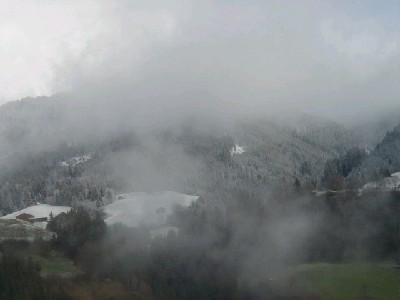
    Drove back
    later through some very foggy weather and a very long dark tunnel.


    the end

  • austrian alps – 3

    When I
    went back I described my experiences to Ralf and Kramer. Kramer said that he
    would ask his David, his 13 year old son, to accompany me the next day. David
    had been very aloof all the while and had been quite indifferent to me just
    like any young boy would be to a guest. And another thing is he did not speak
    any English at all, and all of my German vocabulary could be inscribed on a rice
    grain in bold font.


    Anyway I
    thoroughly enjoyed the dinner that evening – as I was starved after my
    exploits. I was troubled that Kramer’s wife had to take extra trouble to
    prepare vegetarian food as I was the only vegetarian. I tried to convince her
    that I don’t mind eating just raw vegetable salad – and though bread, cheese
    and salad were indeed my meal for most cases – still she used to go ahead and
    cook some nice veg dish sometimes.


    Later Ralf
    and Doris helped clean and dry all the vessels and I too found a way to make
    myself useful by assembling them neatly on the table as they were processed.
    This concept of the guest easing the responsibilities of the host was new to me
    and I felt it was a very neat idea to be implemented wherever I go.


    The next
    day, David and I set off up the trail again. We tried to get some conversation
    going – I said something in English to which he helplessly shrugged his
    shoulders – later he said something in German to which I had no option but to
    do the same… so we finally gave up and proceeded silently. We were going in the
    direction of where I had been to earlier and I tried to tell him there was no
    way further – which fell on deaf ears. We finally reached the edge of the cliff
    and I stopped.


    He just
    walked on down the slope.


    I just
    stood there totally dumbfounded gaping at him as he stood at the bottom next to
    the frozen stream and waving at me to get on with it. I wondered how he
    could’ve just walked like that. Slowly against my better judgement – I tried to
    find some way – I held on to a tree… then skid down a few feet and clung on
    tighter for dear life – then slowly somewhat regained my footing and looked for
    the next foothold – and released the grip on the tree searching for a new one.
    I took a full ten minutes to join him while he waited impatiently with an
    amused expression on his face. Then we started walking up the slope, along the
    banks of the stream.


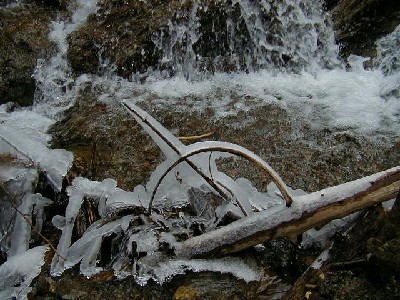
    The frozen
    stream was just beginning to thaw out as it was spring, and the resulting
    trickle of water led to the formation of some spectacular icicles.


    We saw no
    animals along the way save one colony of ants just starting to get into
    business. However I saw some skull and some hoof marks.


    Here are
    two of the most extraordinary icicles.


    This one
    David broke off and held in his hand against the sunlight for my photo.


    At one
    point we had to cross the stream. David neatly jumped across. I very warily
    hesitated… the challenge was not just jumping the distance but also to land
    safely on the slippery floor. He encouraged me… and after a lot of deliberation
    and first handing over my camera, I took the leap. I made it but my elation was
    only momentary as I lost my balance and my foot went into the icy 1 foot deep
    water… brr. I howled out due to the chill and pulled it out. There was this one
    second of silence… and then we both burst into laughter for a long time. And at
    that instant we became great friends. I had to remove my shoe and squish all
    the water out of my socks, but after I put it on again, the cold in my foot
    eventually became the least of the challenges.


    The slope
    was very steep at some places, and at some other places, there was no space on
    the stream bank to walk, and we had to take a slight detour.


    At many
    such points, proceeding further seemed totally ridiculous. At some point I
    would be confronted by an almost vertical slope and at these places I used to
    exclaim one the few useful German words I knew – “Unmoglich!!” (Impossible) And
    David would readily retort “Nicht Unmoglich!!” climbing up just to prove his
    point, as if there was some invisible ladder, and again climb down
    effortlessly.


    At one
    point, I was totally stuck… neither able to go back nor forward nor up nor down.
    I was against the face of the cliff, a full 15 feet above what was relatively
    horizontal ground. I was holding on to the root of a tree, David was standing
    at a platform on top. He kept urging me to come on… and offered me his hand. I
    took it and suddenly remembered I was around 70+ kilos and he was a 13 year old
    kid and hurriedly took it back. I said “Bitte warten” – “Please wait” and just
    took a whole five minutes to carefully assess my precarious situation. This was
    my first experience with mountains and I was definitely no Tom Cruise (recall
    MI-2). If I was to fall, I wouldn’t lose my life, but definitely my limbs. Here
    there would be no way any ambulance would make it, first of all getting in
    touch with anyone itself would take eternity. My well being would depend
    absolutely on no one else other than my own alertness and sound common sense.


    I realized
    that my immediate next ambition in life was to find the next stable handhold.
    Slowly I tested all the different possibilities… which one would be strong…
    also planned… almost like chess… if I do that, next I can do that… I’ll get
    stuck again… not that way, etc. David, now more patient than earlier, waited
    while I figured the whole thing out. Finally step by step, I managed to pull
    myself up after which he gave a very encouraging cheer.


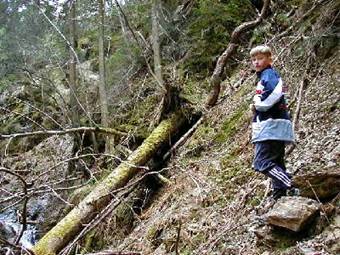
    (This
    picture was close to that point, and it shows the gradient – not very clearly
    though – at the right edge of the picture)